
Rowan DeWitt
Skidmore College Classics Major Portfolio
Three Faces of the Devil
Latin Seminar: Biblical Epic, Spring 2022
Learning Goal: Read Greek and Latin prose and poetry within their larger cultural and historical settings
Core Literacy: Information
Biblical Epic was an interesting class for me as we were translating biblical Latin from the early Medieval period. For my final paper I wrote about how the literary figure of Satan was visually characterized throughout different periods of time, inspired by my interest in the snake in Genesis. There are many connections that I found between descriptions of the Christian Satan and the Roman world, such as later depictions of his goat-like features having possibly been drawn from the Greco-Roman god Pan to (literally) demonize ‘pagan’ gods. Going into the present day I examined a 2020 graphic novel where Satan is drawn to resemble Julius Caesar.
Much of my interest in classics centers around tracing the echoes of the ancient Roman world into our modern culture. I am fascinated by how cultural or literary narratives evolve over time and adapt to the context in which they are being (re)told. I believe this paper successfully brought together analysis of the Latin texts which we were reading in class with my own literary and artistic analysis of other works and the research I had conducted.
Read Here
Mask of Agamemnon Response Comic
Greek Art and Archeology, Fall 2022
Learning Goals: Read critically and analyze closely literary texts and modern scholarship
Core Literacy: Visual, Information
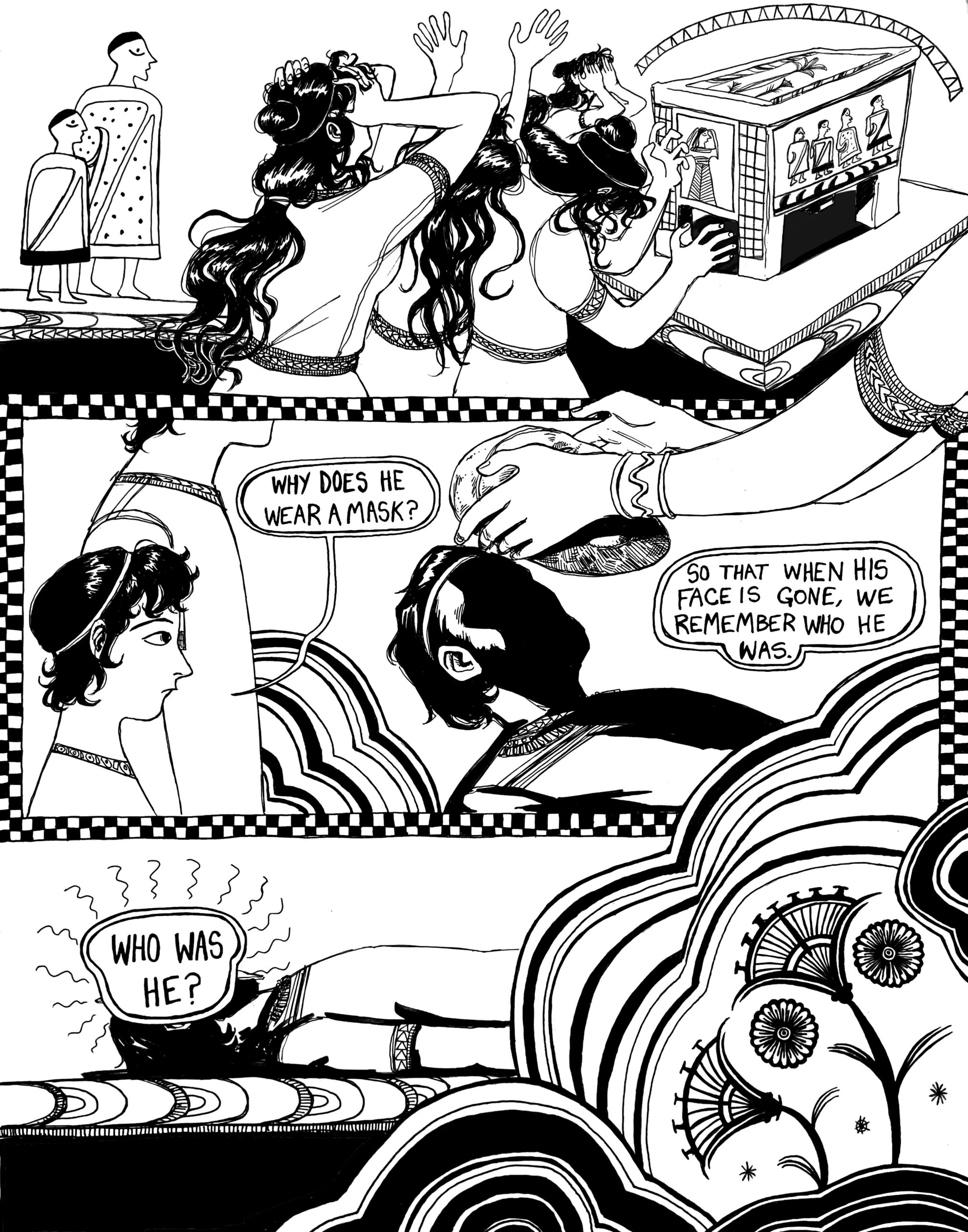
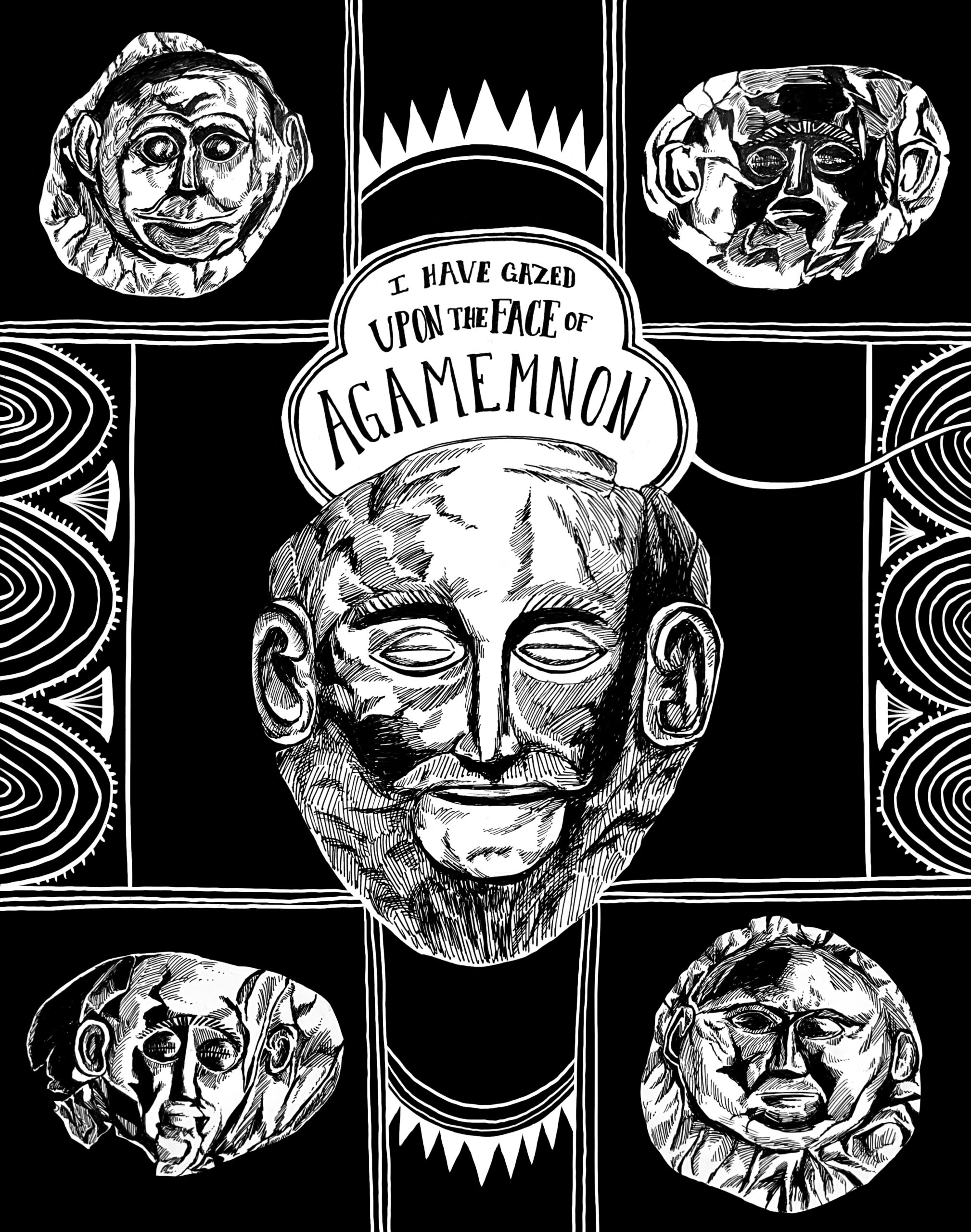
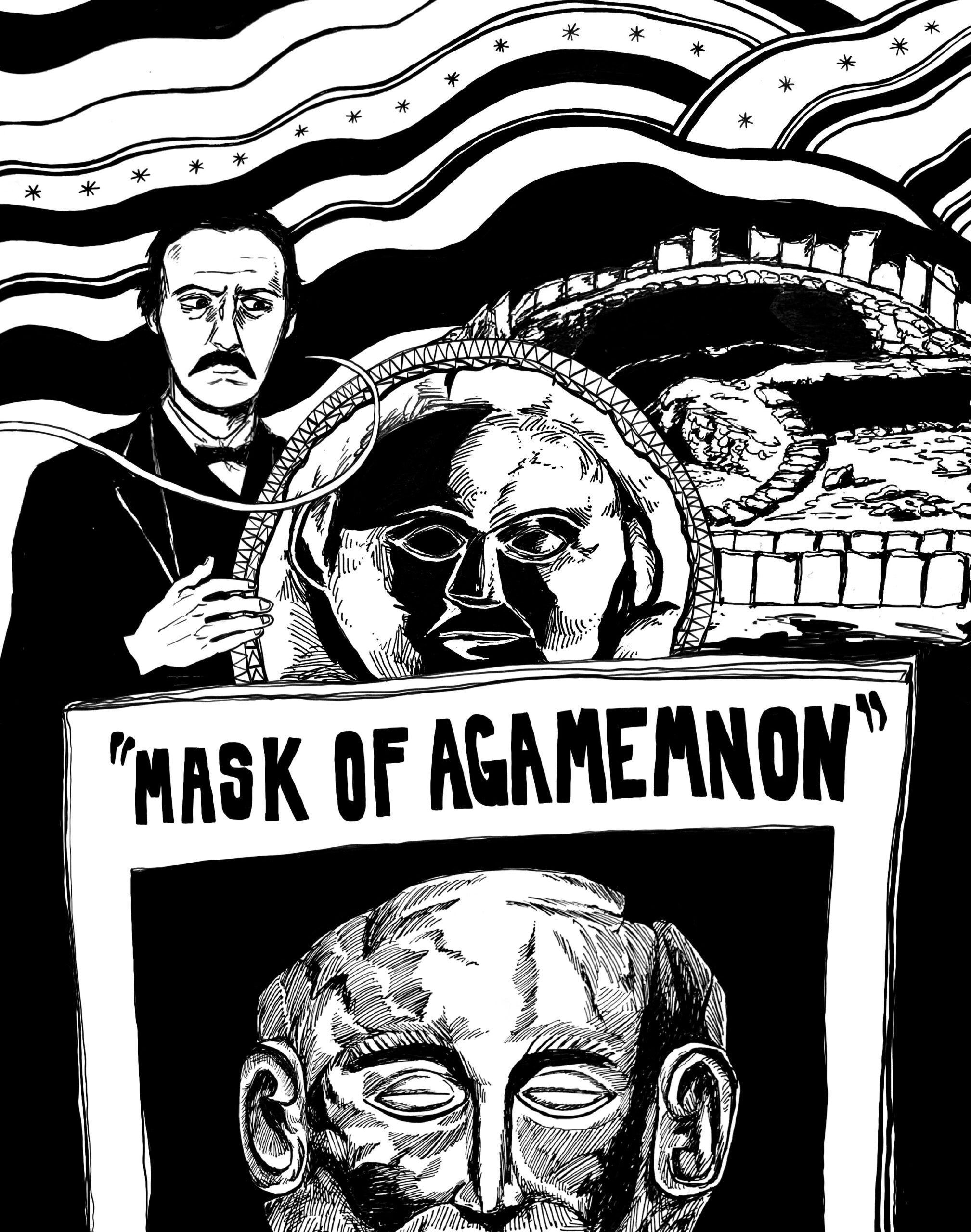
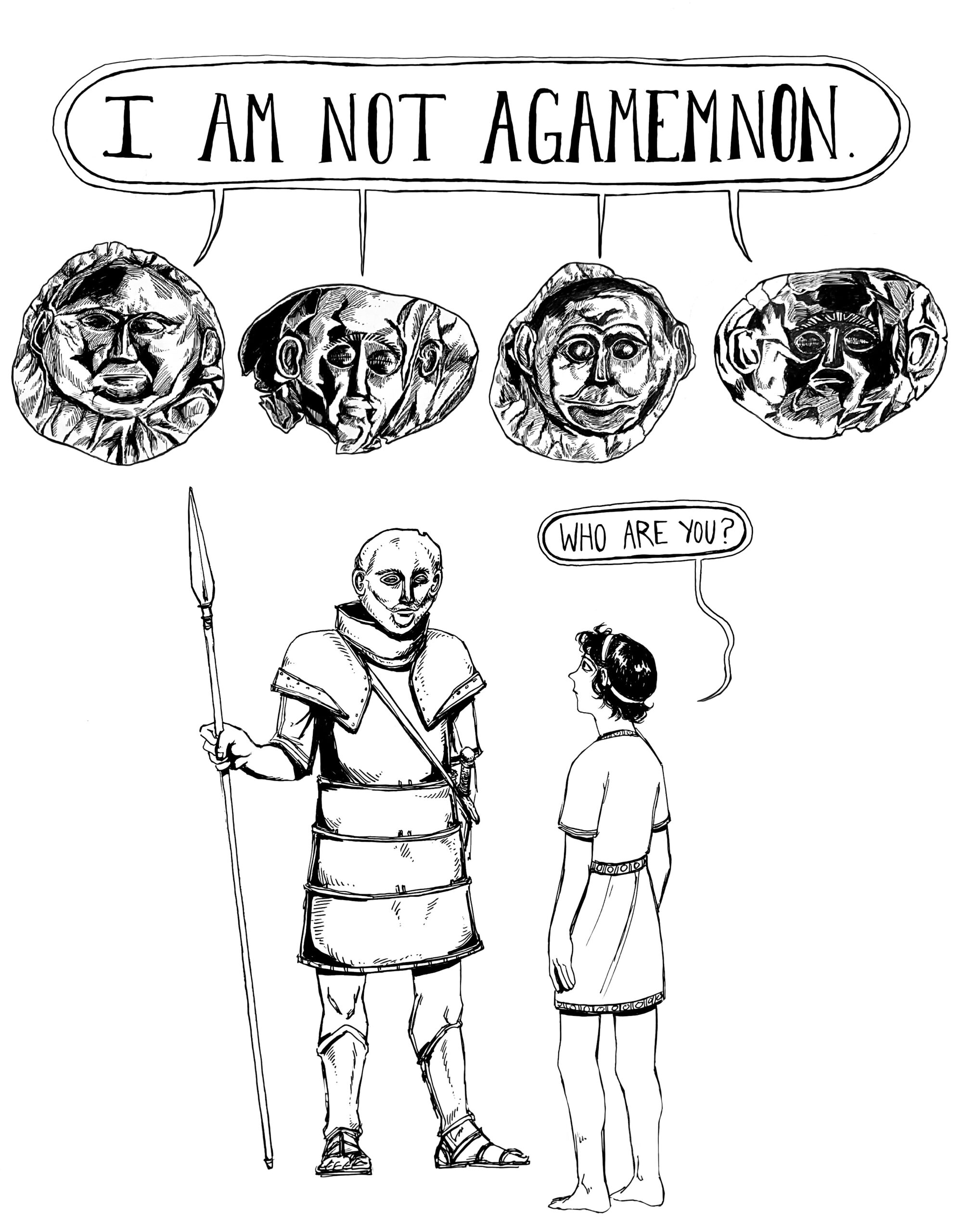
This project was a response to my research about the ancient Mycenaean funerary mask NM 642, known as the Mask of Agamemnon. Discovered in 1876 by archeologist Heinrich Schliemann, the mask has been subject to much scholarly debate regarding its authenticity as a Bronze Age artifact. What interested me the most about the story of the mask’s reception by Schliemann and following scholars is Schliemann’s obsession with the Iliad, using the text as a historical resource upon which to base his archeological practice. It was because of this that he referred to NM 642 as ‘Agamemnon’, although the assignment of this identity would be inaccurate. Additionally, there is evidence to suggest that the mask Schliemann referred to as ‘the face of Agamemnon’ was not even NM 642 but another mask in the group. I found that there was a tragic irony in the mis-identification of a funerary mask, as the object was once intended to preserve the identity of its bearer.
For this piece I took visual inspiration from ancient Mycenaean designs found on frescoes and pottery, integrating that unique visual style into a comic format.
“They Love Whom They Lower”: The Place of Gladiators in Roman Society
Rise of Rome, Fall 2022
Learning Goal: Read and analyze historical documents within their social contexts and evaluate the role of the individual in ancient cultures
Core Literacy: Information
Rise of Rome was a history course which covered the Roman Republic up until the beginnings of its collapse. I wanted to use this paper to learn about Roman gladiators, a subject I had been interested in for a while. I didn’t go into my research with a specific question in mind, rather, I wanted to absorb all I could find and direct my thesis from what stood out to me. I ended up fascinated by the duality of how gladiators were seen by the Romans—simultaneously they were performers who sold their bodies, infames of the lowest social class, yet also represented the most highly valued Roman concept of virtus, exemplifying Rome’s warlike nature and obsession with strength.
This assignment also followed the thread of my interest in the evolution of certain narratives. I drew connections between this tension with gladiators exemplifying everything that Rome values while also being condemned to the lowest social class and our modern-day obsession with ancient Rome. As seen in blockbuster movies like Gladiator, we find the ancient world alluring because we see it as violent and hedonistic. We watch movies like Gladiator which romanticise the violent aspects of ancient culture in the same way the Romans watched their real gladiators: condemning its baseness without taking our eyes away.
Read Here
Graffiti as a Social Dialogue in Ancient Pompeii
Materials, Meaning, and Making in the Ancient Mediterranean, Fall 2023
Learning Goals: Identify and assess selected artifacts and monuments within their cultural contexts
Core Literacies: Information
This class centered around the material culture of the ancient Mediterranean, so for my final project I wanted to examine the corpus of graffiti that has been preserved in Pompeii. I found that this paper presented me with new challenges that I had not yet fully faced in my academic career. Although I was deeply interested in the subject, I struggled to find a unique thesis within such a niche field of study. I started by looking at the academic literature which has studied the graffiti, and used this to then synthesize an analysis which focused less on individual graffito and their messages but the patterns in which they appear. There are many dimensions of Roman graffiti which are unique to Rome, yet many as well which reflect the same human tendencies as today’s graffiti. People have always been interested in making their mark, and leaving behind evidence of themselves in the places they inhabit. From the enormous body of graffiti found in Pompeii we have seen that there was not only wide literacy, but also a pervasive engagement with the act of writing. The graffiti responded to each other to form a larger dialogue of individuals and spaces.
Read Here
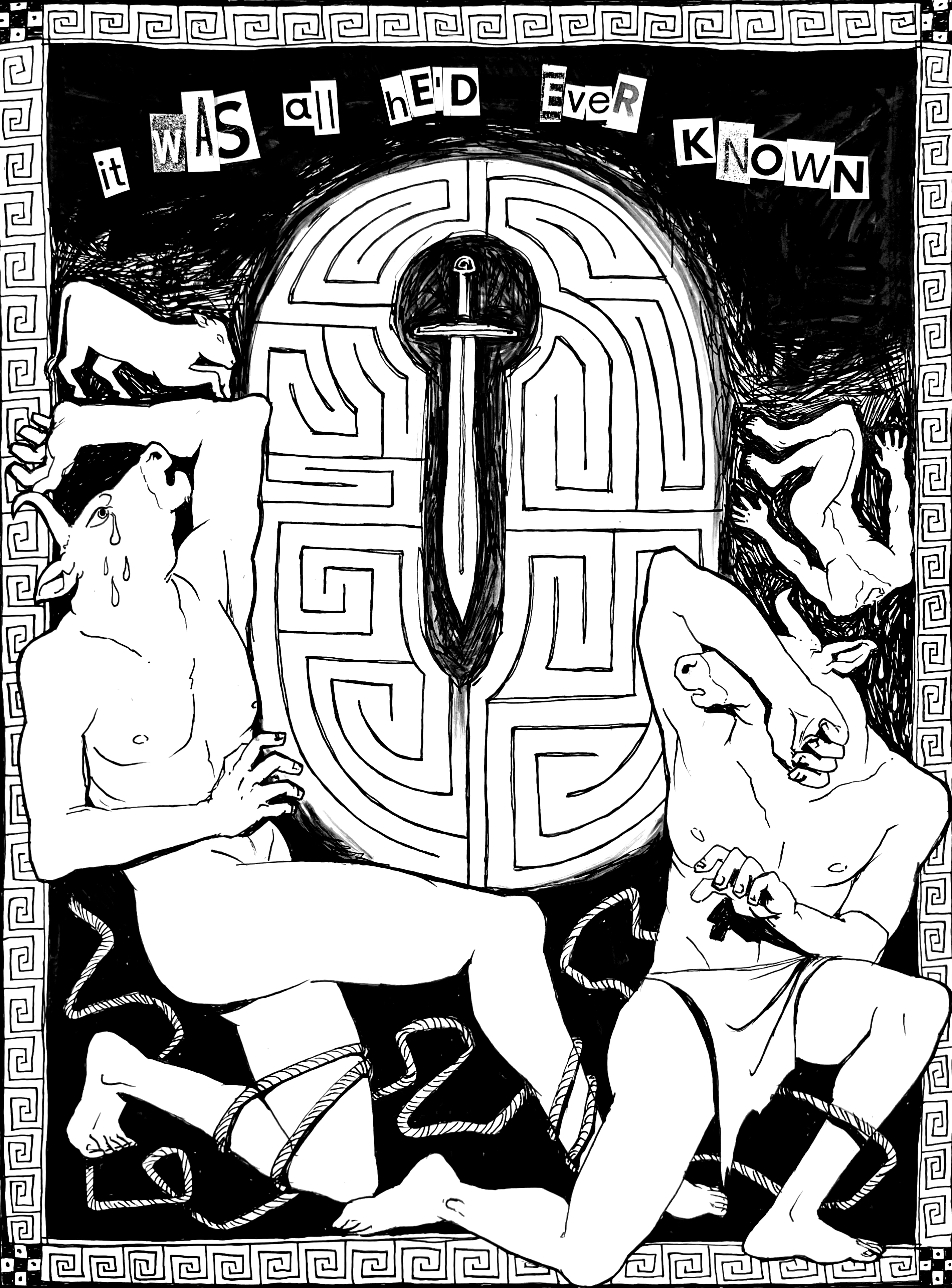
Theseus and the Minotaur Myth Response, “It Was All He’d Ever Known”
Classical Mythology, Fall 2023
Learning Goals: Identify and assess selected artifacts and monuments within their cultural contexts
Core Literacies: Visual
I have been long interested in the story of the Minotaur, especially in the Minotaur itself. The final assignment for this class was to create a response to a myth, and I immediately chose to examine the Minotaur and attempt to reframe him as a sympathetic or tragic figure. I have been greatly influenced by Ovid’s Heroides, which reinterpreted many Roman myths from the perspectives of the women in them; from this, I began planning a composition for a drawing which would encapsulate many of the ideas I was having about the Minotaur. I have the Minotaur himself drawn twice, each figure directly posed after a representation of him on an ancient black- or red-figure vessel. Around the whole composition is a simple border, also inspired by ancient designs. Behind the Minotaur looms a maze; since both figures are cowering and one is crying, it gives the effect that he is recoiling from the labyrinth which has trapped him. Instead of the Minotaur being the source of violence and terror, he is a victim, finally represented with a sword at the center of both the maze and the composition. The sword represents both Theseus and the human hand which has been the true source of violence. Above the center of the composition are the words “It was all he’d ever known.” I wanted to use the story of the Minotaur to examine cycles of violence. If the Minotaur had only ever been a victim to the violence of others, it is perhaps not his intrinsic nature which made him a monster.
Reflection
This selection of works is the culmination of final projects for every Classics class I have taken at Skidmore, excluding only my capstone in Latin this fall semester. I was very engaged with the material of every class and excited to find topics relating to each course which I could build my research and work off of. My longstanding interest in classics has allowed me to establish a common theme to which I may circle my studies back around to in some way, relating to broader academic topics which I am excited about.
Although these projects were the only ones which I could pick from, I am still happy to present every one of these works as my portfolio for this major. I feel lucky that I am so proud of my work for every class. I think it is because I have this strong sense of my own interests which I can exhibit through my academic works. At first I wanted to display each item in my portfolio in order of what I personally find most to least engaging, leading with what I believe to be the absolute strongest or most successful. What I realized, however, once I had collected my works together and reviewed them all—some of them for the first time in years—was that chronological order would suit them the best. While it may not necessarily show my work getting ‘better’ or more successful over time I do believe there is a progression visible which is worth observing.
Unsurprisingly this assignment prompted much consideration of my time studying classics at Skidmore. There was no class that I didn’t enjoy or feel enriched by. Having a second major in Studio Arts did complicate my Classics major, and vice versa. There are certain courses in each department that I wish I could have taken but couldn’t make work in my schedule. Going into the major my freshman year I had a very specific expectation for what I wanted to study; this was largely focused on Latin poetry and the history of the late Roman Republic. This goal was not met in the way I expected, as the major offered me many other classes with broader subject matter. I learned more about the ancient world as a whole than I initially thought I would, albeit at the expense of having more specialized knowledge. Yet on the other hand, I do not come away from this experience seeing that in a negative light. Reviewing my work from the past four years I have seen a different kind of ‘specialty’ emerge: a consistent return to ideas of narrative, as was touched upon in most of my reflections.
I prefer to look at historical, literary, or mythological stories through the lens of what those stories can reveal about their own context and creation. A huge part of why I value classics so highly is the extraordinary richness of the material as it has been built upon and upon and upon for quite literally thousands of years and still retains deep relevance and human-ness to today.
This interest and the ways in which it has informed my academic work also has had a great influence on my artistic practice. As I completed my art major in tandem with my classics studies, my work in visual storytelling also became increasingly focused on narrative. Additionally, I began to challenge myself artistically to engage further with medium and format to propel, obscure, or complicate aspects of storytelling. Much like the hypocrisy of the modern viewer that I explored in my Gladiators in Roman Society paper, I began to experiment with viewer implication in my own art, expanding on the relationship between audience and image.
At the beginning of assembling this portfolio I was a bit surprised to see that I only had five works to include. I felt as though there should have been more. Now I feel differently. I feel a personal connection to each of these works, and I can associate each of them with a specific point in my academic career, be it a challenge, a success, or a moment where everything clicked into place. None of these were completed without a struggle, yet—as corny as it may be—all carry in them a part of me.